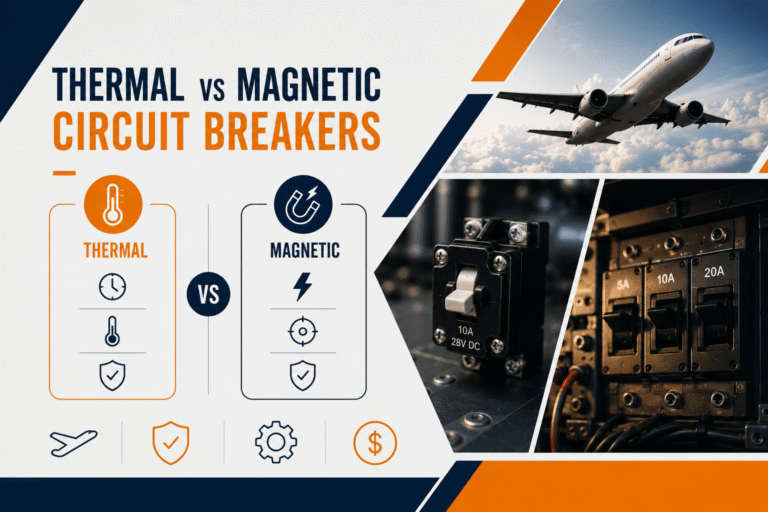
















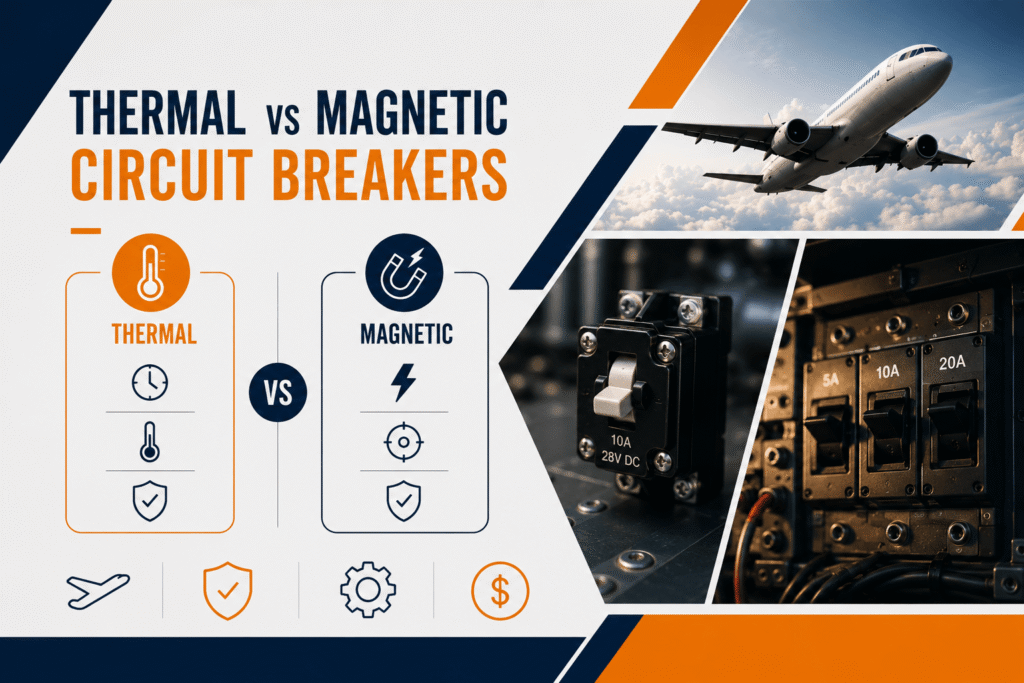
When an aircraft’s electrical system experiences a fault, the difference between a controlled shutdown and a cascading failure often comes down to one small component: the circuit breaker. Yet not all circuit breakers behave the same way. Two of the most common protection technologies used across aerospace platforms are thermal circuit breakers and magnetic circuit breakers, and choosing the right one can directly affect flight safety, maintenance costs, and system reliability.
If you’re an aerospace engineer, MRO specialist, or procurement manager trying to decide which circuit breaker technology fits your aircraft system, this guide breaks down how each works, where each excels, and how to choose the right protection device for your application.
Why Circuit Breaker Selection Matters in Aerospace
Modern aircraft contain hundreds of circuit breakers protecting everything from flight controls to cabin lighting. Each one exists to perform three core functions: isolating circuits for maintenance, managing electrical load distribution, and protecting components from overcurrent damage. Choosing the wrong breaker type for a given application can mean nuisance trips during normal operation, delayed response during an actual fault, or premature component failure , all of which translate into costly downtime and safety risk.
That’s why understanding the fundamental difference between thermal and magnetic tripping mechanisms is essential before specifying a breaker for any new build, retrofit, or MRO replacement program.
How Thermal Circuit Breakers Work
Thermal circuit breakers rely on a bimetallic strip or disc that heats up in proportion to the current flowing through it. As current rises above the rated threshold, the strip bends due to differential thermal expansion between its two metal layers, eventually tripping the mechanism and opening the circuit.
Key characteristics of thermal breakers:
- Response time is inversely proportional to current , the higher the overload, the faster the trip
- Sensitive to ambient temperature, which can shift the trip point (unless temperature-compensated)
- Simple, rugged, and cost-effective construction
- Ideal for protecting wiring and components against sustained overheating
This is the technology behind widely used aerospace-grade breakers such as the KLIXON series, which is engineered specifically to meet AS58091 and MIL-C-5809 aerospace standards. If you want a deeper technical breakdown of how these devices are built and certified, our detailed guide on KLIXON aircraft circuit breakers covers 15 essential facts every engineer should know, including trip curves, MTBF data, and replacement guidelines.
How Magnetic Circuit Breakers Work
Magnetic circuit breakers use an electromagnetic coil instead of a bimetallic element. When current exceeds the calibrated threshold, the magnetic field generated by the coil pulls an armature that trips the mechanism almost instantly , regardless of ambient temperature.
Key characteristics of magnetic breakers:
- Trip response is largely independent of ambient temperature
- Extremely fast response to sudden, high-magnitude current spikes (short circuits)
- Precise and repeatable trip thresholds
- Often used where consistent, temperature-stable tripping is mission-critical
Because magnetic breakers respond almost instantaneously to short-circuit-level currents, they are frequently specified for systems where even a fraction of a second’s delay could cause equipment damage or safety hazards.
Thermal vs Magnetic: Side-by-Side Comparison
| Feature | Thermal Circuit Breaker | Magnetic Circuit Breaker |
| Trip mechanism | Bimetallic strip/disc | Electromagnetic coil |
| Temperature sensitivity | Can vary (unless compensated) | Largely unaffected |
| Response to overload | Gradual, inverse-time curve | Near-instant on high current |
| Best suited for | Sustained overcurrent protection | Sudden short-circuit protection |
| Cost | Generally lower | Generally higher |
| Common aerospace use | General system protection, wiring protection | Critical, fault-sensitive circuits |
Which One Should You Choose?
The right answer depends entirely on the application:
- For general aircraft wiring and load protection, thermal circuit breakers , particularly temperature-compensated KLIXON variants , offer proven reliability, aerospace certification, and a strong balance of cost and performance.
- For circuits where instant response to short circuits is non-negotiable (navigation systems, primary flight controls, emergency power), magnetic or hybrid thermal-magnetic breakers may be the safer specification.
- For extreme operating environments with wide temperature swings, from high-altitude cold to ground-level heat, temperature-compensated thermal breakers typically outperform standard thermal designs, since their trip point stays consistent across -55°C to +125°C.
Many modern aerospace protection systems actually combine both technologies into hybrid thermal-magnetic breakers, giving engineers the gradual overload protection of a thermal element alongside the instant-trip capability of a magnetic mechanism.
Maintenance and Lifecycle Considerations
Regardless of which technology you choose, circuit breakers are wear items with a defined service life. Aerospace maintenance teams should track:
- Visual inspection every 1,000 flight hours
- Annual functional testing
- Replacement when trip characteristics drift outside tolerance, or when a unit exceeds roughly 10 years in service
Ignoring these intervals is one of the most common (and preventable) causes of in-service circuit breaker failure.
Sourcing Certified Aerospace Circuit Breakers
Whether you need thermal, magnetic, or hybrid circuit breakers for a new aircraft build, retrofit program, or AOG replacement, working with a certified aerospace parts distributor ensures you get genuine, traceable components that meet FAA and EASA requirements. Inventechs Technology supplies a full portfolio of aerospace-grade circuit breakers, including certified KLIXON products, backed by technical support from our engineering team.
Need help selecting the right circuit breaker for your aircraft system? Request a quote or contact our engineering team for application-specific guidance, technical datasheets, and AOG support.
Final Thoughts
Thermal and magnetic circuit breakers each solve a different problem: one guards against sustained overload, the other against sudden short circuits. Understanding this distinction isn’t just academic; it’s a decision that affects aircraft safety, maintenance schedules, and long-term operational cost. For a deeper look at how one of the industry’s most trusted thermal breaker families is engineered, don’t miss our full breakdown of KLIXON aircraft circuit breakers and their real-world applications across critical aerospace systems.